Cleanroom Tablets: Essential Features
Features to Look for in Cleanroom Tablets
Choosing the right cleanroom tablet is crucial for maintaining contamination control and meeting regulatory requirements in pharmaceutical environments like 503A and 503B compounding pharmacies. Tablets designed for cleanrooms must prevent particle buildup, withstand frequent cleaning, and integrate seamlessly with documentation systems. Here’s a quick breakdown of three options:
Blue Line Cleanroom Tablets: Purpose-built for cleanrooms with a lightweight, seamless polymer design. Features include magnetic connectors, glove-friendly touchscreens, and ThinManager integration for centralized management.
Teguar Rugged Tablets: Durable with stainless steel or antimicrobial plastic housings. Offers high IP ratings (up to IP69K) and compatibility with cleaning agents for heavy-duty sterilization.
Apple iPad with Cleanroom Case: A cost-effective option when paired with a cleanroom-grade case. Provides app-based functionality but depends on the case’s durability and seal for cleanroom suitability.
Each option has strengths depending on cleaning protocols, IT infrastructure, and budget. Below is a quick comparison of their features.
Quick Comparison
Feature | Blue Line Cleanroom Tablet | Teguar Rugged Tablet | iPad with Cleanroom Case |
|---|---|---|---|
Material | Aerospace-grade polymer | Stainless steel or plastic | Consumer-grade with case |
Weight | ~2.6 lbs | ~3.7–4.3 lbs | Lightweight with case |
IP Rating | IP65 | IP65–IP69K | IP65 (case-dependent) |
Glove Usability | Works with 3 layers of gloves | Glove-friendly touchscreen | Functional with gloves |
Cleaning Resistance | IPA, VHP, Spor-Klenz, H₂O₂ | Alkaline, acid safe | Case-dependent durability |
Best Use Case | GMP grades A–D, documentation | High-pressure sterilization | Budget-friendly, light use |
For facilities prioritizing compliance and ease of sterilization, Blue Line tablets are a top choice. Teguar tablets excel in durability for heavy-duty use, while the iPad with a case offers a budget-conscious alternative for less demanding environments.
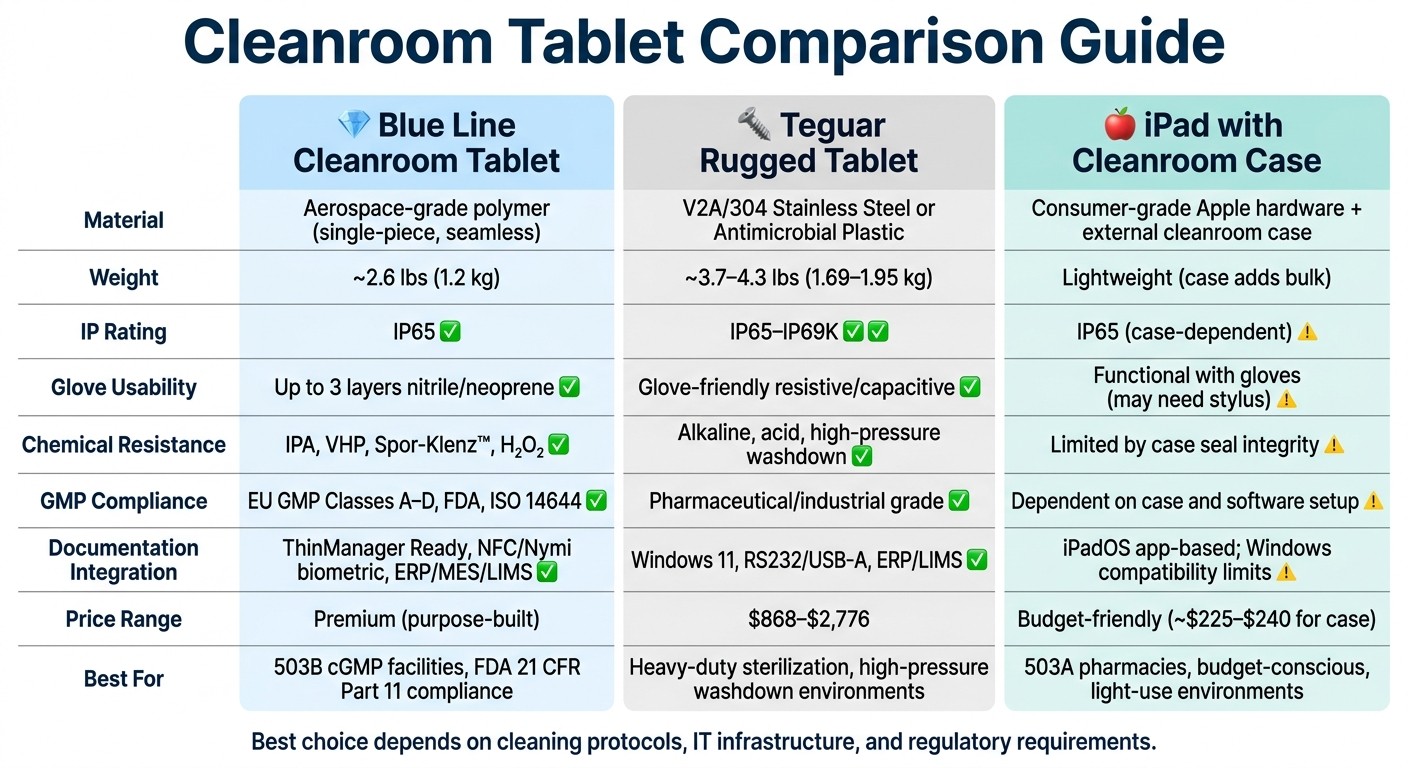
Cleanroom Tablet Comparison: Blue Line vs Teguar vs iPad
1. Blue Line Cleanroom Tablets
Blue Line tablets are purpose-built for pharmaceutical cleanrooms, adhering to EU GMP Classes A–D, FDA, and ISO 14644 standards. Unlike consumer or healthcare tablets modified for cleanroom use, these are designed from scratch with contamination control as the top priority.
“Most existing tablets for demanding environments were designed for the healthcare industry, which means that while they can endure quick wipe downs, they will degrade quickly if subjected to the rigorous cleaning practices of even the lowest classes of cleanroom.” - Niels Pedersen, CEO, Blue Line
Design and Build
The standout feature of Blue Line tablets is their physical design. Made with a single-piece aerospace-grade polymer casing, these tablets eliminate crevices where contaminants could hide. The smooth, seamless construction reduces contamination risk while being 80% lighter than 316 stainless steel, yet offering similar chemical resistance. At just 2.7 lbs (1,230 g), they’re easy to handle. The surfaces are smooth and slightly slanted to discourage particle buildup. Plus, the tablets are built to endure repeated cleanings with IPA, VHP, Spor-Klenz™, and H2O2.
The IP65-rated sealed design swaps traditional charging ports for a flush-mounted magnetic connector, avoiding open slots that could trap residue or compromise the device during cleaning. For wired connections, the optional Cleanroom Hub offers an IP65-compliant enclosure with one Ethernet port and three USB ports.
Usability in Cleanroom Environments
Blue Line tablets are tailored for environments where gloves are mandatory. The 13-inch capacitive multi-touch display (2,880 × 1,920 resolution, 600 nits brightness) works seamlessly with up to three layers of nitrile or neoprene gloves. For secure access, an optional Nymi-compatible NFC reader lets users log in without removing PPE or typing passwords.
Beyond usability, these tablets simplify documentation. They integrate directly with ERP, MES, and LIMS systems, enabling real-time data entry and digital batch record management. The ThinManager Ready setup allows applications to run from a central server, eliminating the need for local OS maintenance inside the cleanroom - a major win for IT teams in regulated environments. In 2026, a global pharmaceutical company replaced 2–3 fixed terminals per station with over 60 Blue Line Mobile Operator Stations and Cleanroom Tablets, cutting hardware costs and reducing installation complexity.
Next, let’s explore another rugged tablet option designed specifically for cleanroom operations.
2. Teguar Rugged Tablets
Teguar specializes in rugged tablets tailored for industrial and healthcare settings. Their product range includes stainless steel models for pharmaceutical and food production cleanrooms, medical-grade devices, and general-purpose rugged tablets designed to meet stringent contamination control requirements. Prices start at $868.14 for the 8” slim rugged tablet (TRT-A5780-08S) and reach $2,776.14 for the 13” medical tablet (TMT-5957-13).
Cleanroom Suitability and Physical Design
Teguar’s cleanroom-focused tablets are built with V2A/304 stainless steel or antimicrobial plastic housings. These materials help eliminate grooves and hinges where particles and microbes could accumulate. The antimicrobial plastic option further reduces surface bacteria by up to 99%. These tablets are compatible with cleaning agents such as isopropyl alcohol, bleach, Caviwipes, CIDEX, and quaternary ammonium compounds.
All models feature fanless passive cooling to avoid disturbing settled contaminants, a critical feature for cleanroom environments. Depending on the model, IP ratings range from IP65 to IP69K. The IP69K-rated stainless steel units are built to withstand high-temperature, high-pressure water jets, making them ideal for rigorous sterilization protocols.
Usability with PPE and Documentation Integration
Teguar tablets are designed for use in cleanrooms, even with double gloves. Their resistive touchscreens maintain high responsiveness in controlled environments. Powered by Windows 11 Pro/IoT, these tablets integrate seamlessly with systems like ERP, LIMS, and pharmacy management platforms. Optional features, such as 1D/2D barcode scanners, RFID/NFC readers, and smart card readers, enhance efficiency in tasks like batch record management and medication verification.
For connectivity, Teguar tablets offer Wi-Fi 6, Bluetooth 5.2, and optional 4G/5G LTE, ensuring real-time synchronization with central systems.
“Pharmacy and Medication Management: Medical computers assist in medication dispensing and management, including medication verification, inventory control, barcode scanning, and integration with electronic prescribing systems.” - Teguar
The table below highlights the differences among Teguar’s three main series to help determine the best option for your cleanroom needs:
Feature | Stainless Steel Series | Medical Tablet Series | Rugged Tablet Series |
|---|---|---|---|
Primary Material | V2A/304 Stainless Steel | Antimicrobial Plastic | Ruggedized Composite |
IP Rating | Up to IP69K | IP65–IP67 | IP65 |
Cleaning Method | High-pressure/high-temp washdown | Medical-grade disinfectants | Standard industrial cleaners |
Touchscreen | Resistive or P-Cap | Glove-friendly Resistive | Gorilla Glass P-Cap |
Best Use Case | Pharmaceutical/food cleanrooms | Clinical/healthcare settings | Industrial/field documentation |
With Teguar’s rugged and cleanroom-ready designs covered, the next section will explore how the Apple iPad, paired with a cleanroom case, balances mainstream functionality with contamination control.
3. Apple iPad with Cleanroom Case
Mainstream devices like the Apple iPad can work effectively in controlled environments when paired with the right protective case. While not specifically designed for cleanrooms, the iPad meets documentation standards when enclosed in a cleanroom-grade case. For instance, the FutureNova iBioShield 10X case, priced between $225 and $240, encases the iPad in either 316L stainless steel or FDA-approved polycarbonate. This setup provides an IP65 rating, which ensures protection against dust and low-pressure water sprays. The case’s smooth, gap-free surfaces and flush membrane buttons are designed to minimize particle buildup.
Cleanroom Suitability and Physical Design
These enclosures are built to endure standard cleanroom disinfectants without breaking down. Weighing under 16 oz (450 g) without the iPad, the iBioShield 10X keeps the device lightweight and easy to handle for extended periods. For high-risk environments, some models feature a 150-micron explosion-proof screen cover.
The cases also include proprietary IP65 magnetic connectors, ensuring sealed charging and data transfer. This design balances durability with ease of use, maintaining smooth device operation in cleanroom conditions.
Usability with PPE and Documentation Integration
Even with up to three layers of nitrile or neoprene gloves, the iPad’s touchscreen remains fully functional when housed in its cleanroom case. This makes it a practical tool for documentation tasks in controlled environments. The device’s cameras (up to 10MP rear and 1080p/1440p front) enable barcode scanning, image capture for quality records, and video conferencing. Connectivity options include WiFi 6 and Bluetooth 5.3, with additional USB and Ethernet access available via the magnetic port.
The iPad setup is also highly adaptable for software integration. It supports ThinManager Ready configurations, allowing seamless server-based application management. Additionally, it pairs with Bluetooth barcode scanners, cleanroom-grade keyboards, and label printers, ensuring compatibility with MES, SOP, and quality assurance systems. These features maintain the strict contamination control required in regulated environments.
“The advantage of this mobility solution was the ability to integrate into the clients cleanroom while minimizing cost and downtime. A truly mobile solution that upholds all cleanroom standards can be implemented from day one.” - Michael Asmussen, Business Development Manager, Blue Line A/S
For facilities needing mounting options, these enclosures are compatible with VESA 75×75 mm patterns for wall mounts and benchtop holders. They can also be used with stainless steel trolleys to create mobile workstation setups.
Pros and Cons
Choosing the right tablet comes down to balancing cleaning requirements, IT setup, and how long operators will use the device.
Blue Line tablets stand out with their lightweight polymer design (about 2.6 lbs) and compliance with GMP standards for cleanroom grades A through D. Their sealed magnetic connector is especially useful for daily sterilization routines. However, the standard 1-year warranty, even with an option to extend to 2 years, might feel limiting for some users.
Teguar tablets excel in ruggedness, offering top-tier ingress protection (up to IP69K) and legacy port options like RS232 and USB-A. These features make them ideal for environments that demand high-pressure washdowns or steam cleaning at temperatures up to 176°F (80°C). The downside? They’re heavier (around 3.7–4.3 lbs) and have exposed ports, which can complicate thorough decontamination.
The iPad with a cleanroom case is a budget-friendly option with user-friendly operation, access to a wide app ecosystem, and high-quality cameras for documentation tasks. However, its cleanroom performance depends entirely on the case’s durability and seal. Additionally, facilities using Windows-based MES or SOP platforms might face compatibility challenges.
Here’s a quick comparison of the three options:
Feature | Blue Line Cleanroom Tablet | Teguar Rugged Tablet | iPad with Cleanroom Case |
|---|---|---|---|
Cleanroom Suitability | GMP grades A–D; no crevices; magnetic connector | IP65 to IP69K; stainless/rugged options | Case-dependent; risk of crevice particle buildup |
Physical Design | ~2.6 lbs (1.2 kg); 0.43 in (11 mm) thin | Heavy-duty; Gorilla Glass; ~3.7–4.3 lbs (1.69–1.95 kg) | Consumer-grade; adds bulk with external case |
PPE Usability | Tested with 3 layers of nitrile/neoprene gloves | Resistive or capacitive; glove and stylus compatible | Capacitive; may require stylus or specialized gloves |
Documentation Integration | ThinManager Ready; Nymi/NFC biometric login | Windows 11; RS232/USB-A for legacy systems | iPadOS; app-based; potential Windows compatibility limits |
Chemical Resistance | Withstands VHP, H₂O₂, Spor-Klenz | Alkaline and acid safe; waterproof | Limited by case seal integrity and material |
Conclusion
When weighing the options between Blue Line, Teguar, and iPad-based solutions, it’s clear that no single tablet excels in every category. The best choice depends on factors like your facility’s cleaning protocols, IT setup, and regulatory requirements.
For 503B outsourcing facilities adhering to FDA cGMP and 21 CFR Part 11, the Blue Line Cleanroom Tablet stands out. Its sealed design, compatibility with ThinManager®, and Nymi biometric authentication support data integrity and audit readiness. Plus, its lightweight build helps minimize operator fatigue during extended shifts.
If durability is your top priority, the Teguar CT13S9-GMP is a solid contender. With its IP69-rated stainless steel housing, it can withstand water flow rates of up to 16 liters per minute, high pressure, and temperatures as extreme as 176°F (80°C).
On the other hand, for facilities focused on affordability and ease of use, an iPad with a cleanroom case may be the right fit - especially for 503A pharmacies. However, its effectiveness largely depends on the quality and durability of the protective case.
For compounding pharmacies navigating USP <797> and <800> standards, tools like 503Pharma offer valuable guidance. They help teams stay informed on compliance updates and understand how equipment choices impact environmental monitoring and contamination control. Choosing the right cleanroom tablet not only ensures compliance but also boosts operational efficiency.
FAQs
What IP rating do I need for my cleanroom cleaning process?
When selecting an IP rating, it’s important to match it with your cleaning methods. For everyday use, go with at least IP65, which offers solid protection. If you’re using disinfectant sprays, step up to IP67 to safeguard against temporary water immersion. For more rigorous cleaning processes, like Water for Injection (WFI) rinses or Clean-In-Place (CIP) wash-downs, you’ll need the durability of an IP69/IP69K rating to handle those demanding conditions.
How can I validate tablet use for 21 CFR Part 11 compliance?
To ensure tablets comply with 21 CFR Part 11, it’s essential that both the device and its software support unchangeable audit trails and include validation checks to safeguard data integrity. A solid documentation system with clearly defined acceptance criteria is also critical. Regular system audits should be conducted to confirm both compliance and optimal performance. For compounding pharmacies facing these challenges, 503Pharma offers educational resources designed to simplify the process and help maintain regulatory standards.
Which tablet features most reduce contamination risk during daily wipe-downs?
To minimize contamination risks during cleaning, opt for tablets with a smooth, crevice-free design that prevents debris from accumulating. Look for devices with a high ingress protection rating, such as IP65, IP66, or IP69, to ensure they can withstand exposure to cleaning agents. Tablets with stainless steel housings offer extra durability, and features like a touchscreen lock or a physical ON/OFF button can help prevent accidental inputs while cleaning.
Download Now