Reusable vs. Disposable Cleanroom Garments
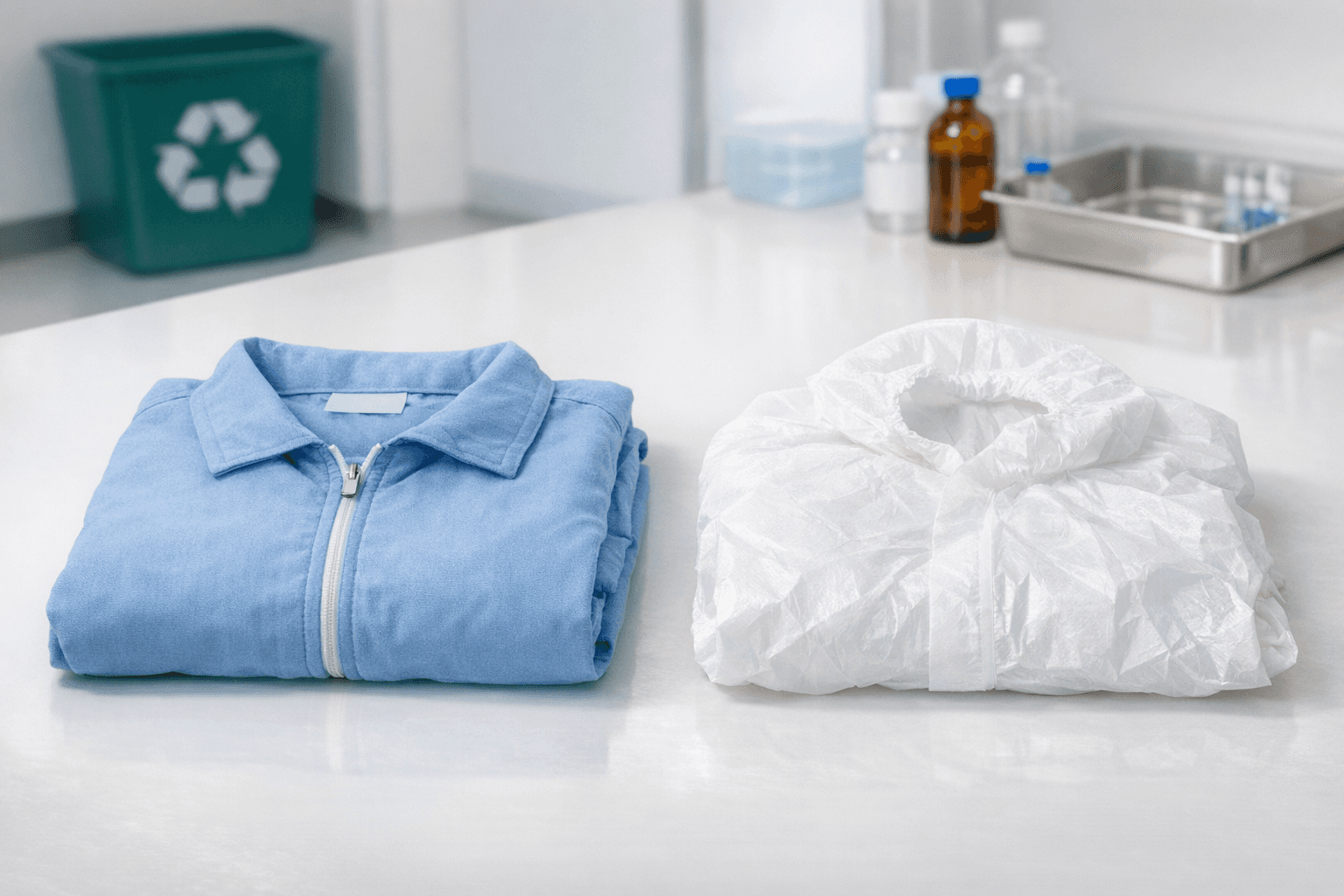
Reusable vs. Disposable Cleanroom Garments
Cleanroom garments are essential in 503A and 503B compounding pharmacies to prevent contamination, as humans cause over 70% of it. Choosing between reusable and disposable garments depends on factors like contamination control, cost, and material performance. Here's what you need to know:
Reusable garments: Made from polyester, they last 40-50 cycles with proper care but require specialized laundering and tracking systems. They are cost-effective over time and reduce waste significantly.
Disposable garments: Made from non-woven materials like Tyvek, they provide consistent protection and eliminate cross-contamination risks but generate more waste and recurring costs.
Key Differences:
Contamination: Reusables shed particles over time; disposables maintain low shedding.
Cost: Reusables save money long-term; disposables have higher ongoing expenses.
Waste: Reusables cut waste by 93-96%; disposables create more landfill impact.
Quick Comparison:
Feature | Reusable Garments | Disposable Garments |
|---|---|---|
Material | Polyester with carbon grid | Non-woven (Tyvek, SMS, etc.) |
Lifespan | 40-50 cycles | Single use |
Particle Shedding | Increases over time | Consistently low |
Cost Effectiveness | Long-term savings | Higher recurring costs |
Waste Impact | Reduced by 93-96% | High waste generation |
Your choice should align with your cleanroom's ISO classification, contamination risks, and operational needs. Reusables excel in cost and waste reduction, while disposables offer convenience and consistent sterility.
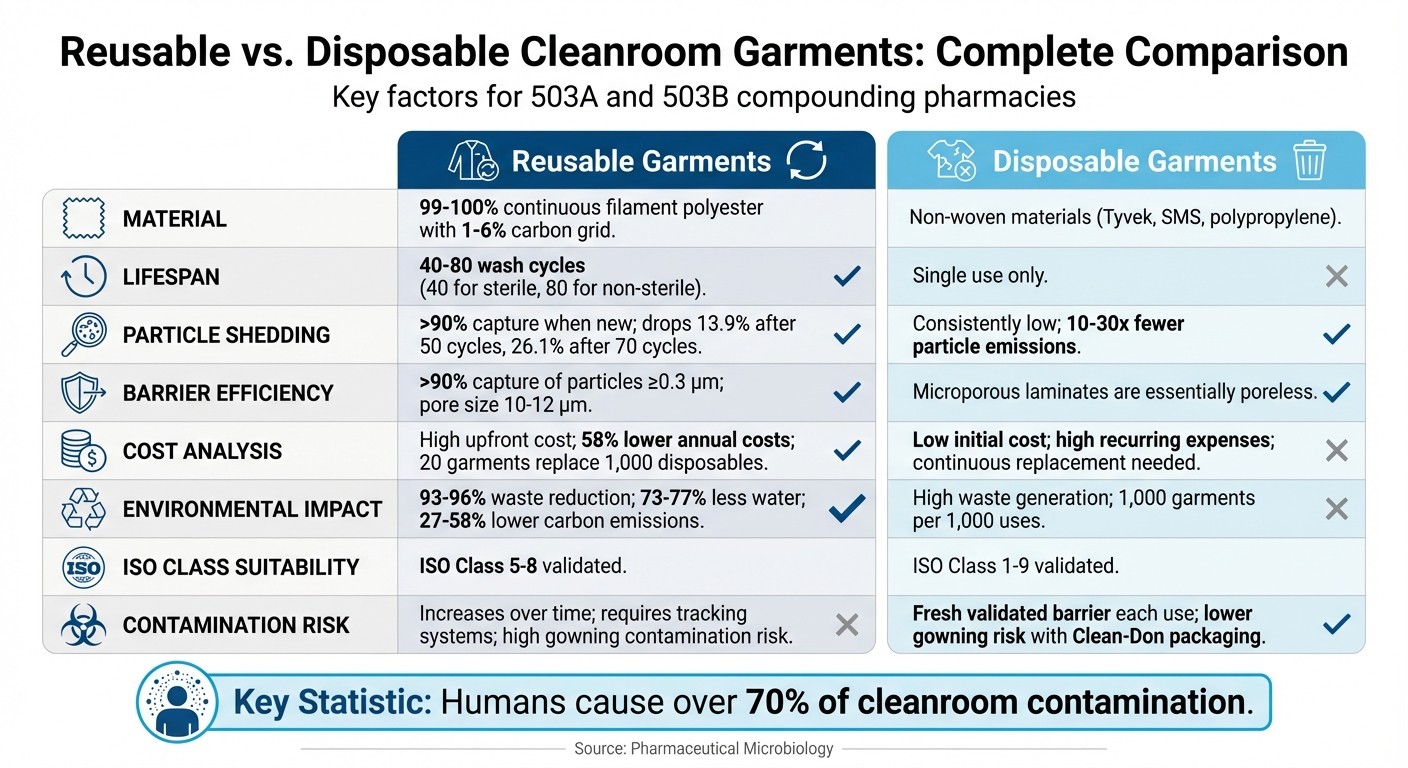
Reusable vs Disposable Cleanroom Garments Comparison Chart
Reusable Cleanroom Garments
Features and Benefits
Reusable cleanroom garments are crafted from 99–100% continuous filament polyester, a material that resists fiber breakdown and minimizes particle shedding - critical for maintaining cleanroom standards [5][1].
To combat static buildup, these garments incorporate 1–6% carbon yarns arranged in a grid pattern. This design ensures permanent electrostatic discharge (ESD) properties, with surface resistivity ranging from 10^5 to 10^11 Ω-2, effectively preventing contaminants from being attracted to the fabric [5].
High-density weaves, combined with a process called calendaring (which compresses the fabric to reduce pore size), significantly enhance the barrier efficiency of these garments. As a result, high-quality reusable gowns can capture over 90% of particles measuring 0.3 µm or larger [6]. For added durability, seams are constructed using lapped (flat-felled) techniques with double-needle stitching and silicone-free polyester thread, eliminating exposed fabric edges that could compromise cleanroom integrity [5].
"Selection and correct use of these garments has a significant impact on the performance of the cleanroom. Use of the optimum gowning reduces particle shedding and can allow the use of lower air change rates."
Jan Eudy, Cleanroom and Contamination Control Consultant [5]
However, garment longevity depends on proper care. A January 2021 study revealed that 100% monofilament polyester garments experienced fabric thinning, carbon grid degradation, and a bacterial filtration efficiency (BFE) drop exceeding 25% after just five washes. After 50 decontamination cycles, these issues became more pronounced, underscoring the importance of tracking wash cycles to ensure contamination control standards are upheld [1][11].
Reusable garments require specialized laundering processes. These include pass-through machines, 18 MΩ deionized water, and non-ionic detergents, followed by sterilization through gamma radiation (25–40 kGy) or autoclaving. Barcode or RFID systems are used to monitor the number of cycles, ensuring garments remain within their 30–50 cycle lifespan [3].
The performance of these garments directly determines their suitability for cleanroom environments across various ISO classifications.
ISO Class Requirements
Thanks to their advanced features, reusable cleanroom garments are validated for use in ISO Class 5 through ISO Class 8 environments [2]. The specific garment style and frequency of changes depend on the cleanroom's classification level:
ISO Class | Cleanroom Type | Recommended Reusable Garment Style | Frequency |
|---|---|---|---|
ISO 5 (Class 100) | Grade A/B (Critical) | Full coveralls, hoods, boots, gloves, masks | Every entry |
ISO 6 (Class 1,000) | Buffer Area | Frocks or coveralls, hoods, boots | Daily or every entry |
ISO 7 (Class 10,000) | Buffer Area | Frocks or coveralls, hair covers, shoe covers | Daily |
ISO 8 (Class 100,000) | Ante-Area | Frocks, hair covers, shoe covers | Daily |
For 503A and 503B compounding pharmacies, reusable garments meet USP <797> and USP <800> compliance requirements when laundered in ISO-certified facilities and validated for sterility at a 10^-6 sterility assurance level (SAL) [2]. Typically, buffer areas (ISO Class 7) and ante-areas (ISO Class 8) use coveralls or frocks. In the most critical ISO Class 5 environments, full coverage - including attached hoods and boots - is essential [2].
"The gown is the first line of defense in aseptic processing - therefore, technicians need a robust method to verify the suitability of cleanroom garments."
Tim Sandle, Head of GxP Compliance, Bio Products Laboratory [6]
To maintain compliance, garments should undergo visual inspections after every laundering cycle. This is especially important after 40–50 cycles, when fabric deterioration - such as thinning or carbon grid break-up - becomes more likely [6]. Additionally, all garment components, including snaps, zippers, and threads, must be compatible with gamma irradiation or autoclaving to ensure they remain effective and safe for cleanroom use [5].
Disposable Cleanroom Garments
Features and Benefits
Disposable cleanroom garments are crafted from non-woven materials, with popular options including spunbonded fabrics, flash-spun materials like Tyvek, meltblown fabrics, and SMS (Spunbond-Meltblown-Spunbond) tri-laminates [5].
These specialized fabrics act as a strong barrier against hazardous liquids, sprays, and dust. Tyvek and microporous laminates provide excellent protection due to their pore-free structure, while SMS offers a more breathable option - 25 times more breathable, in fact - without compromising contamination control [5] [9].
"Disposable, single-use apparel is used during cleanroom manufacturing of toxic or biohazardous products or when the process uses hazardous chemicals such as acids or alkali."
Jan Eudy, Corporate Q A Manager, Cintas Corporation [5]
Sterile disposable garments undergo validation at a sterility assurance level (SAL) of 10⁻⁶ [5] [12]. These garments are individually packaged in cleanroom-safe bags and feature colorimetric indicators that shift from yellow to red after gamma radiation exposure, confirming their sterility [12].
To further prevent contamination, seams are either single-needle stitched or heat-sealed using pressure and heat-activated adhesives, ensuring fibers remain intact. Additionally, all components are made from silicone-free polyester to minimize the risk of airborne molecular contamination [5].
The single-use design eliminates the danger of cross-contamination from prior use or improper laundering. Each garment provides a fresh, validated barrier with consistent particle filtration, unlike reusable options, which may lose effectiveness after 50 or more wash cycles [5] [1]. This makes disposable garments the preferred choice for handling toxic, biohazardous, or highly acidic/alkaline substances [5].
These robust features align with the ISO class requirements discussed below.
ISO Class Requirements
Disposable cleanroom garments are designed to meet the rigorous standards of various ISO classes, making them suitable for cleanroom environments ranging from ISO Class 1 (ultra-clean) to ISO Class 9 (general cleanliness) [13] [14]. The choice of garment style and material depends on the ISO classification and the specific substances being handled.
ISO Class | Recommended Garments | Typical Material |
|---|---|---|
ISO 1-3 | Full coveralls, hoods, overboots, gloves, masks | High-performance, low-shedding materials (Tyvek, Microporous), ultrasonic seams [13] [14] |
ISO 4-5 | Sterile coveralls, hoods, boots, masks, goggles | SMS or Tyvek, sterile (10⁻⁶ SAL), individually packaged [13] [15] |
ISO 6-7 | Frocks or coveralls, hoods, shoe covers, masks | |
ISO 8-9 | Smocks/Frocks, bouffant caps, shoe covers | Polypropylene (PP) or PE-coated nonwoven materials [13] [15] |
For critical environments (ISO Class 1-5), garments made from high-performance materials with ultrasonic seamless welding or laser cutting are essential to minimize particle generation [13]. These garments are typically vacuum-sealed or double-bagged to ensure they remain contamination-free until they are ready for use [13] [2]. Among materials, Tyvek is considered the cleanest, followed by microporous film laminates and SMS tri-laminates [2].
In 503A and 503B compounding pharmacies, sterile disposable garments meet USP <797> and USP <800> standards when used in buffer areas (ISO Class 7) and primary engineering controls (ISO Class 5) [2]. For less critical spaces, such as ante-areas (ISO Class 8), non-sterile polypropylene frocks with full-length zippers are a practical option. These garments offer better particle containment compared to snap-front closures and are effective at preventing contamination from street clothing [5] [16].
Contamination Control Comparison
For compounding pharmacies, understanding the differences between reusable and disposable cleanroom garments is critical for maintaining sterility and compliance. The materials and lifecycle characteristics of each type lead to notable variations in contamination control. Reusable garments, made from 100% continuous monofilament polyester, minimize fiber breakage when new but tend to shed more particles as they go through repeated wash and sterilization cycles [6]. Disposable garments, on the other hand, are made from non-woven materials like polypropylene, polyethylene, or microporous film laminates, which maintain consistently low particle shedding with every use [3][5].
When it comes to barrier efficiency, the performance of reusable and disposable garments depends on their pore size and fabric structure. Reusable polyester garments, with tightly woven fabric, can capture over 90% of particles measuring 0.3 µm or larger. However, their pore size, typically 10–12 µm, tends to increase slightly with garment age [6][1]. Disposable garments, particularly those made from microporous film laminates, offer a better barrier by eliminating the pores found in woven fabrics [5]. This makes them especially effective at preventing the penetration of hazardous liquids and fine particles.
Sterility maintenance is another area where these garments differ significantly. A study conducted in January 2021 by AstraZeneca and the University of Glasgow found that monofilament polyester garments retained a low dispersion rate of 0.2 microbe-carrying particles per second after 50 decontamination cycles - a 194-fold reduction compared to standard undergarments. However, by 70 cycles, the garments showed a 26.1% drop in particle removal efficiency due to the breakdown of the carbon-encapsulated grid [1]. Disposable garments eliminate this issue entirely, as they provide a fresh, validated barrier with each use.
"Sterile garment systems show a better performance, achieving 10 to 30 times fewer particle emission rates in wider movements and almost zero microbiological release."
Building and Environment Journal [17]
To summarize, the table below highlights the key differences in contamination control features between reusable and disposable cleanroom garments.
Contamination Control Comparison Table
Feature | Reusable Garments | Disposable Garments |
|---|---|---|
Primary Material | Woven monofilament polyester (often with carbon grid) [1][3] | |
Particle Shedding | Increases over time; drops 13.9% after 50 cycles, 26.1% after 70 cycles [1] | Low and consistent; no degradation from reuse [3] |
Barrier Efficiency | >90% capture of particles ≥0.3 µm when new [6] | Microporous laminates are essentially poreless [5] |
Pore Size | Tyvek and microporous laminates have no pores [5] | |
Sterility Performance | Validated up to ~50 cycles (SAL 10⁻⁶) [5] | Single-use; guaranteed fresh barrier each time [5] |
Microbiological Release | 0.2 MCPs/second after 50 cycles [1] | 10 to 30 times lower particle emission rates [17] |
Durability | High; designed for 50+ cycles [4] | Low; lightweight substrate prone to tearing [3] |
Gowning Contamination Risk | High risk of floor contact during donning [9] | Lower risk with vacuum-sealed, Clean-Don packaging [9] |
Cost Comparison
When evaluating cleanroom garment expenses, it's important to look beyond the initial sticker price. Reusable garments require a much higher upfront investment compared to disposables, but they often lead to substantial long-term savings [18]. On the other hand, disposable garments might seem budget-friendly at first, but their recurring purchase costs and biohazardous waste disposal fees can pile up over time [18][19]. These contrasting cost dynamics set the stage for a closer examination.
Reusable garments come with additional costs related to their upkeep. These include specialized laundering with high-purity deionized water and non-ionic detergents, sterilization (through gamma radiation or autoclaving), quality inspections, and occasional repairs [10]. Pharmacies can either lease or own reusable garments. Leasing offers a lower initial cost but may include fees for lost or damaged items, which can increase monthly bills by 5% to 25% [3]. Ownership, while requiring a higher upfront investment, tends to deliver significant savings over time [3].
The long-term cost benefits of reusable garments become clear when considering their lifespan. A single reusable garment can endure 40 to 80 wash cycles, depending on whether it undergoes sterilization (40 cycles) or simple laundering (80 cycles) [20][21]. Over its full lifecycle, 20 reusable garments can take the place of approximately 1,000 disposable ones [23]. According to the American Reusable Textile Association, cleanrooms that switch to reusable garments can cut their annual garment costs by 58%, translating into an estimated $120 million in savings across the U.S. cleanroom industry [20][22].
"While reusable clothing and garments typically cost more to purchase, the fact that you can get multiple uses out of them dramatically reduces the cost per use."
For compounding pharmacies, the choice between reusable and disposable garments often depends on their operational scale. Smaller 503A pharmacies, which handle lower compounding volumes, might find disposables more convenient despite their higher per-use costs. Conversely, high-volume 503B facilities stand to benefit from the long-term savings reusables offer, particularly when they collaborate with specialized laundry services to handle decontamination processes [1][3].
Cost Comparison Table
Cost Factor | Reusable Garments | Disposable Garments |
|---|---|---|
Initial Purchase Price | High [18] | Low per-unit cost [18] |
Maintenance Costs | High (laundering, sterilization, inspections, repairs) [10] | None (single use) [18] |
Expected Lifespan | 40–80 wash cycles (40 for sterile, 80 for non-sterile) [20][21] | Single use [19] |
Disposal Costs | Low (applied at end-of-life after multiple uses) [10] | High (biohazardous waste fees per use) [10] |
Hidden Fees | 5–25% increase for loss/damage in lease contracts [3] | Additional storage and disposal fees [18] |
Annual Cost Savings | Approximately 58% lower garment costs [20] | Baseline recurring expense |
Total Cost of Ownership | Lower due to reuse (20 garments replace 1,000 disposables) [23] | Higher due to continuous replacement [18] |
Environmental Impact Comparison
Reusable cleanroom coverall systems stand out for their ability to significantly reduce energy use, resource consumption, greenhouse gas emissions, and water usage compared to disposable alternatives [8][7]. The scale of this difference is striking: providing 1,000 cleanroom uses requires just 20 reusable garments, whereas disposables demand 1,000 individual items [24].
One of the most dramatic benefits of reusable garments is their impact on solid waste reduction. A single reusable garment can replace 40–60 disposable ones during its lifecycle, cutting solid waste by an impressive 93–96% [8][24][4]. Even after completing 50 cycles of use, these garments often avoid the landfill, finding a second life in other markets instead [24].
When it comes to water and energy use, reusable systems maintain a clear edge. They consume 73–77% less water and 34–59% less process energy than disposables, even after factoring in the laundering process [8][4].
"The reusable cleanroom coverall system shows substantial improvements over both disposable cleanroom coverall systems in all environmental impact categories."
Eric Vozzola, Environmental Clarity [8]
The carbon savings are equally compelling. In the U.S. alone, switching to reusable coveralls saves over 141 million megajoules of non-renewable energy each year - enough to offset the annual carbon emissions of 1,650 cars [22]. For 503A and 503B pharmacies, which are increasingly prioritizing sustainability alongside regulatory compliance, these environmental advantages make reusable systems an appealing choice for cleanroom operations.
Environmental Impact Comparison Table
Impact Category | Reusable Garments | Disposable Garments |
|---|---|---|
Solid Waste Production | High; 1,000 garments per 1,000 uses [24] | |
Water Consumption | High; consumed during raw material manufacturing [24] | |
Energy Consumption | 34–59% lower process energy [8] | High; energy-intensive polymer manufacturing [24] |
Carbon Footprint | Higher due to manufacturing and disposal [24] | |
Service Life | Single use only [24] | |
End-of-Life Options | Often donated to secondary markets [24] | Typically landfilled; inert polymers do not degrade [24] |
Selection Guide for 503A and 503B Pharmacies
Choosing the right cleanroom garments involves weighing factors like ISO requirements, contamination control, costs, and environmental impact. Each pharmacy's specific compliance needs and operational context will shape the decision.
Start with your ISO classification. For sterile compounding in ISO Class 5 (Class 100) environments, both disposable and reusable garments can work, provided they're properly validated. Full-body coverage - including coveralls, hoods, and boots - is mandatory, as specified in the ISO Class guidelines [2][5]. In ISO Class 7 or 8 areas, frocks or lab coats may suffice [2][16]. If you're operating as a 503B outsourcing facility under cGMP standards, sterile apparel is often a requirement. In this case, reusable garments must be validated to ensure they don't exceed 50 processing cycles [2][4][6][1]. Carefully review these requirements to align with your facility's classification.
Focus on contamination control. Contamination risk is a critical concern. Your garments should trap at least 90% of particles that are 0.3 µm or larger [6]. Disposable garments offer consistent performance right out of the package, while reusable options require robust tracking systems - like barcodes - to ensure they're retired after their validated lifecycle [6][1]. For pharmacies handling hazardous drugs under USP <800>, disposables are often favored because they eliminate the risk of cross-contamination during laundering [5].
Evaluate long-term costs. While disposable garments have a lower upfront cost, a single reusable garment can replace about 50 disposable units [4][23]. However, reusables require ISO-certified laundering, which involves 18 MΩ deionized water and non-ionic detergents [3]. If you lease reusable garments, be mindful of fees for lost or damaged items, as they can increase costs by 5–25% [3]. To determine the true long-term savings, conduct a full lifecycle cost analysis that factors in water, energy, sterilization, and waste disposal expenses [4]. Balancing these costs with your contamination control and compliance priorities will help you make an informed choice.
For more detailed guidance on cleanroom compliance and best practices tailored to 503A and 503B pharmacies, check out 503Pharma. Their resources are designed to support your operations effectively.
Conclusion
Choosing the right cleanroom garments for your 503A or 503B pharmacy is all about finding the right balance. You’ll need to weigh factors like contamination control, regulatory requirements, costs, and environmental considerations. Disposable garments provide consistent performance and eliminate concerns about laundering, while reusable options can offer long-term savings and reduce waste - provided they’re managed correctly. This decision plays a key role in the overall efficiency and safety of your cleanroom operations.
It’s worth noting that human activity is responsible for 80–90% of particle contamination in cleanrooms [25]. This makes your choice of garments a critical defense against contamination. Tim Sandle, Head of GxP Compliance at Bio Products Laboratory, emphasizes this point:
"The gown is the first line of defense in aseptic processing - therefore, technicians need a robust method to verify the suitability of cleanroom garments" [6].
For 503B facilities operating under cGMP standards, sterile apparel with validated lifecycles is non-negotiable. Meanwhile, 503A pharmacies working with hazardous drugs under USP <800> guidelines may find disposable garments to be the safer choice. Your decision should also account for factors like ISO classification, contamination risks, and the scale of your operations. If you’re considering reusable garments, access to ISO-certified laundry services is a crucial factor, as it impacts their feasibility.
Environmental impact is another major consideration. Reusable systems can reduce solid waste by 94–96% [8] and cut the carbon footprint by up to 58% [4]. However, these benefits depend on proper tracking, validation, and the retirement of garments after their recommended 50 processing cycles. Whether you opt for the reliability of disposables or the sustainability of reusables, effective lifecycle management is essential.
For more resources and guidance to help streamline your operations, visit 503Pharma.
FAQs
What are the cost differences between reusable and disposable cleanroom garments?
Reusable cleanroom garments might seem pricey at first because they’re built to withstand many rounds of laundering and sterilization. But here’s the catch: their cost per use drops dramatically over time. In fact, research indicates that facilities can cut costs by up to 58% when they factor in the entire lifecycle of reusable garments. For large-scale operations, this can translate into major savings.
On the flip side, disposable garments need to be purchased anew for every use, which adds up quickly. So, while the upfront expense of reusable garments might appear steep, they’re a clear winner in terms of long-term savings, especially for facilities with high cleanroom usage.
What are the environmental benefits of using reusable cleanroom garments instead of disposable ones?
Reusable cleanroom garments offer a more eco-friendly alternative to disposable ones. Research highlights that switching to reusable options can cut energy use by 34%–59%, reduce greenhouse gas emissions by 27%–57%, and slash water consumption by as much as 77%. On top of that, they produce 94%–96% less landfill waste, as disposable garments typically end up in landfills.
Beyond waste reduction, these garments - crafted from recyclable PET materials - can be cleaned and reused multiple times. This significantly lowers the environmental impact tied to production and disposal. For cleanroom operations in the U.S., adopting reusable garments doesn’t just align with sustainability goals; it could also save millions of dollars annually. It’s a practical and environmentally responsible choice for facilities aiming to reduce their carbon footprint.
What should I consider when deciding between reusable and disposable cleanroom garments?
When deciding between reusable and disposable cleanroom garments, it's essential to weigh factors like contamination control, cost, and operational requirements. These garments must effectively shield against particle contamination and comply with key industry standards, such as ASTM and GMP Annex 1. Reusable garments are typically crafted from woven materials that minimize shedding, while disposable options rely on non-woven fabrics designed for single use. Additionally, a proper fit is critical - ill-fitting garments can lead to increased particle generation, undermining contamination control efforts.
Cost plays a significant role in the decision-making process. Disposable garments may seem budget-friendly upfront, but their frequent replacement and waste generation can drive up long-term costs. Reusable garments, although they require a higher initial investment, offer potential savings over time by spreading costs across multiple cleaning and sterilization cycles. They also tend to have a smaller environmental footprint. That said, it's important to account for ongoing maintenance expenses and the natural wear and tear of reusable materials.
Your facility's infrastructure and regulatory requirements will also shape your choice. Reusable garments demand access to laundering and sterilization facilities, which might not be feasible for all operations. For facilities without these capabilities, disposable garments can be a more practical solution. For example, compounding pharmacies must adhere to guidelines like USP <797>, making compliance a top priority when selecting garments. To navigate these decisions and ensure alignment with industry standards, resources like 503Pharma can offer valuable insights.
Download Now